
Scaffolding accidents cause serious injuries and deaths on construction sites every year, yet most of these incidents are preventable. The majority of scaffolding accidents happen because of simple mistakes during planning, assembly, loading, and maintenance that workers can easily avoid with proper knowledge and attention to safety protocols. Whether you’re new to scaffolding or have years of experience, understanding these common errors will help you keep your worksite safer and more efficient.

Poor planning leads to weak foundations. Improper assembly creates unstable structures. Overloading causes collapse. Each mistake puts workers at risk and can delay your entire project.
This guide covers the most frequent scaffolding errors and gives you practical steps to prevent them. You’ll learn about planning requirements, proper assembly techniques, load limits, fall protection, and maintenance routines that meet safety regulations.
Understanding Scaffolding Safety and Regulations
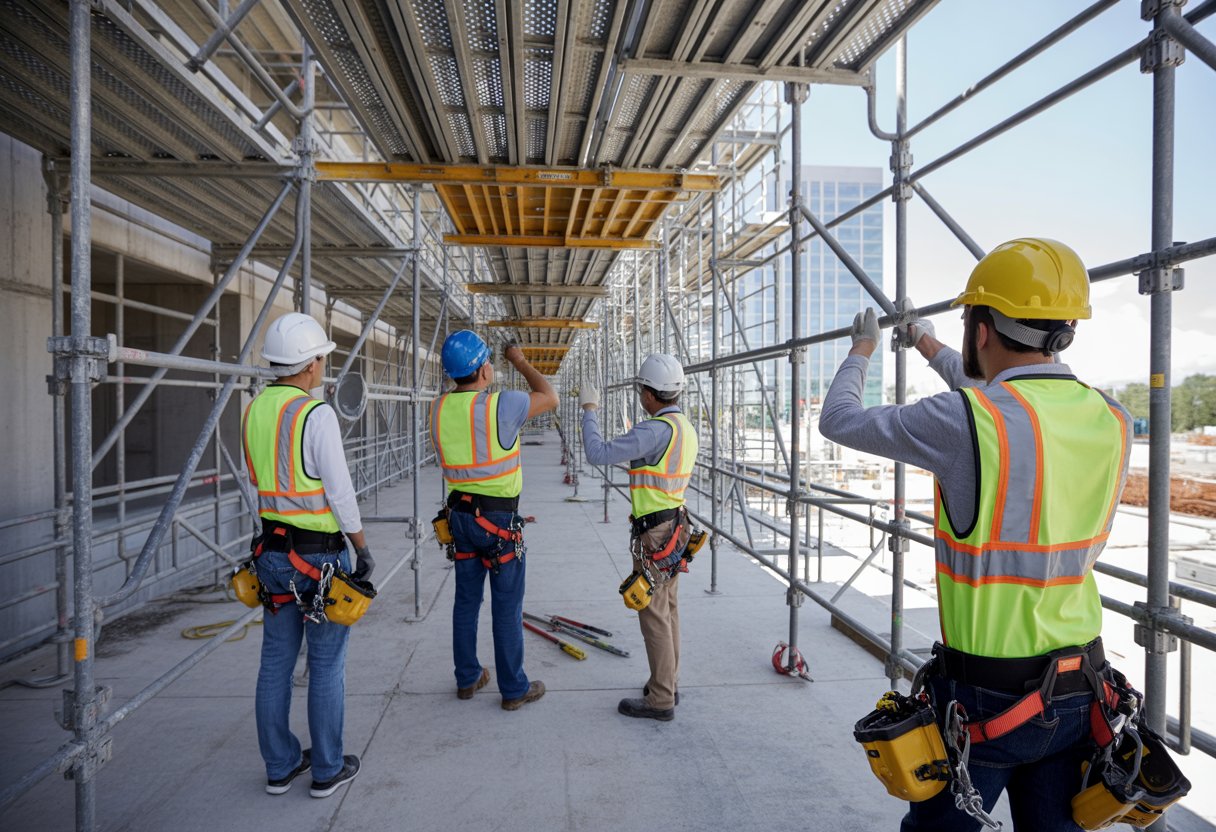
Scaffolding safety depends on following proper regulations and understanding who is responsible for what on your construction site. Legal requirements exist to protect workers, and trained personnel must oversee all scaffolding operations from assembly to daily use.
The Importance of Temporary Elevated Platforms
Temporary elevated platforms give workers safe access to heights where they need to complete tasks. These structures support not just people but also materials and equipment during construction and maintenance work.
Without proper scaffolding, workers face serious risks. Falls from height remain one of the leading causes of workplace deaths and injuries in construction. A stable platform with guardrails, proper decking, and secure footings prevents these accidents.
Your scaffolding must handle the expected loads without collapsing or shifting. Weight limits include workers, tools, and building materials stored on the platform. Overloading causes structural failure and puts everyone below at risk.
The platform needs regular inspections to stay safe. Weather conditions, accidental impacts, and normal wear can compromise the structure’s integrity between uses.
Industry Best Practices and Legal Compliance
The Work at Height Regulations 2005 set out your legal duties when using scaffolding. You must ensure all work at height is properly planned, supervised, and carried out by competent people.
Your scaffolding must meet BS EN 12811 standards for temporary works equipment. This includes specific requirements for:
- Load-bearing capacity and stability
- Platform width and guard rail heights
- Safe access points and ladder systems
- Tie-in points to the structure
- Base plates and foundation requirements
You need a scaffold tag system that shows inspection status. Tags display when the structure was last checked and whether it’s safe to use. Never allow workers on scaffolding marked as unsafe or incomplete.
Documentation matters for compliance. Keep records of inspections, modifications, and any incidents involving your scaffolding equipment.
Roles and Responsibilities of Competent Personnel
A competent person must supervise scaffolding operations on your site. This individual needs specific training, practical experience, and knowledge of relevant regulations. They cannot simply be someone you designate without proper qualifications.
Your competent person inspects scaffolding before first use, after modifications, and at regular intervals (at least every seven days). They also inspect after any event that could affect stability, such as high winds or accidental impacts.
Scaffold erectors require CISRS (Construction Industry Scaffolders Record Scheme) cards or equivalent certification. These workers complete formal training programmes that cover safe assembly, dismantling, and alteration of scaffolding structures.
You must provide adequate supervision for all workers using scaffolding. Even trained personnel need oversight to ensure they follow safety procedures and don’t take shortcuts that create hazards.
Common Planning and Site Assessment Mistakes

Poor planning before scaffold installation creates safety risks and delays. Site conditions, hazards, and scaffold type selection directly affect worker safety and project efficiency.
Skipping Site Inspection and Risk Assessment
You need to inspect the site before any scaffold goes up. Many accidents happen because crews skip this basic step and miss critical dangers.
A proper site inspection identifies ground conditions, overhead hazards, and nearby structures. You should check for unstable soil, underground utilities, and power lines. Weather patterns matter too, especially in areas with high winds or frequent rain.
Risk assessment involves more than a quick look around. You must document hazards and plan how to control them. This includes identifying who might be at risk and what safety measures you need. Without this assessment, you’re working blind and putting your crew in danger.
Overlooking Site-Specific Hazards and Environmental Conditions
Every construction site has unique dangers that affect scaffolding safety. Ground conditions vary widely, from solid concrete to soft soil that shifts under load.
You must account for environmental factors like wind exposure, rain, and temperature changes. Metal scaffolding expands in heat and becomes slippery when wet. Strong winds can destabilise tall structures if you don’t add proper bracing.
Site-specific hazards include nearby traffic, excavation work, and existing structures. Power lines pose electrocution risks if scaffolding touches them. You also need to check for chemicals, dust, or other materials that might weaken scaffold components over time.
Failure to Choose the Appropriate Scaffold Type
Not all scaffolds work for every job. Using the wrong type wastes time and money whilst creating safety problems.
Your scaffold choice depends on work height, load requirements, and site access. Frame scaffolds work well for simple jobs, but complex projects might need tube and fitting systems. Mobile scaffolds suit tasks that require frequent movement, whilst suspended scaffolds are better for building facades.
You must match the scaffold to the actual work conditions. Consider how many workers will be on it, what tools and materials they’ll use, and how long the job will take. A scaffold that’s too small forces dangerous workarounds. One that’s too large costs more than necessary and takes up valuable site space.
Mistakes in Scaffold Assembly and Set-Up

Getting the assembly and set-up right is where many scaffolding problems start. Using the wrong parts, skipping levelling steps, or installing base components incorrectly can create unstable structures that put workers at risk.
Improper Scaffold Assembly and Use of Incompatible Components
You cannot mix parts from different manufacturers or systems when building a scaffold. Each scaffolding system has specific components designed to work together, and combining incompatible parts weakens the entire structure.
Common assembly errors include:
- Using damaged or bent components
- Forcing parts together that don’t fit properly
- Substituting missing parts with items from other systems
- Failing to secure connections fully
When you assemble a scaffold, every component must be compatible and in good condition. Check each piece before installation for cracks, rust, or deformation. All pins, clips, and locks need to engage completely. If a component doesn’t fit easily, it’s likely incompatible with your system.
Improper scaffold assembly often happens when workers rush or lack proper training. You should always follow the manufacturer’s instructions and never improvise solutions with mismatched parts.
Failure to Level and Stabilise the Base
Your scaffold is only as stable as its foundation. An unlevel base causes the structure to lean, creating dangerous working conditions and potential collapse.
Before you start building, assess the ground surface. Soft soil, mud, or uneven terrain cannot support a scaffold safely. You need firm, level ground that can bear the expected load.
Never build a scaffold on unstable surfaces without proper preparation. Use base plates or mud sills to distribute weight across a larger area on softer ground. Check that the scaffold remains plumb (vertically straight) as you build upwards. Even a small tilt at the base becomes a major lean at height.
Incorrect Use of Base Plates, Screw Jacks, and Bracing
Base plates and screw jacks form the foundation of your scaffold system. Base plates distribute the scaffold’s weight to prevent sinking into the ground. Screw jacks allow you to adjust height and level the structure on uneven surfaces.
You must install base plates directly under each vertical standard (upright pole). Never place them on loose bricks, blocks, or timber that can shift. When using screw jacks, don’t extend them beyond the manufacturer’s maximum height—usually around 300-450mm. Over-extension makes them unstable.
Bracing connects the scaffold sections and stops sideways movement. You need both horizontal and diagonal bracing installed according to the design specifications. Missing or loose bracing is a frequent cause of scaffold failure.
Overloading and Load Management Errors
Every scaffold has specific weight limits that must be respected to prevent structural failure. Exceeding these limits or distributing loads improperly creates dangerous conditions that can lead to collapse, injuries, or fatalities.
Exceeding Load-Bearing Capacity
Each scaffolding system has a maximum load-bearing capacity that accounts for workers, tools, and materials combined. This limit isn’t a suggestion—it’s a critical safety threshold.
When you exceed the load-bearing capacity, the scaffold components can buckle, bend, or completely collapse. The consequences affect not only workers on the platform but also anyone working below.
You need to know the exact weight limits for your specific scaffolding system before you start work. Different scaffold types have different capacities:
- Light-duty scaffolds: Support up to 225 kg per platform
- Medium-duty scaffolds: Support up to 450 kg per platform
- Heavy-duty scaffolds: Support up to 675 kg per platform
Don’t stack excessive materials on platforms or allow too many workers in one area. Train your team to recognise warning signs like sagging platforms, bending components, or unstable supports.
Improper Load Distribution Across Platforms
Even when you stay within weight limits, poor load distribution creates serious problems. Concentrating all the weight in one spot puts uneven stress on the scaffold structure.
Spread materials and equipment evenly across the entire platform. Avoid piling heavy items in corners or along one edge. This uneven loading can cause the platform to tilt or destabilise the entire structure.
Position heavier materials near support points rather than in the centre of spans. Keep walkways clear and store materials in designated areas only.
Risks Associated with Overloading Scaffolding
Overloading scaffolding is one of the most common causes of scaffold failures and construction delays. The structural stress from excess weight doesn’t always cause immediate collapse—it can weaken components over time.
Workers may not realise the scaffold is overloaded until it’s too late. Damaged components might not show visible signs of stress before they fail.
You also risk serious legal and financial consequences. Scaffold collapses result in work stoppages, investigations, and potential liability claims. Implement strict weight monitoring and ensure all workers understand the importance of load limits.
Lapses in Fall Protection and Platform Security
Fall protection failures remain one of the leading causes of serious injuries on scaffolding sites. When guardrails are missing or personal fall arrest systems aren’t used properly, workers face life-threatening risks that are completely preventable.
Missing Guardrails, Midrails, and Toe Boards
Your scaffolding platform must have complete edge protection on all open sides. This means installing top guardrails at roughly 1 metre high, midrails positioned halfway between the top rail and the platform, and toe boards at least 150mm high along the platform edge.
Many accidents happen because workers remove these barriers to pass materials through or because they were never installed properly in the first place. Guardrails prevent workers from stepping or falling off the edge during normal work activities.
Toe boards serve a different but equally important purpose. They stop tools, bricks, and other materials from sliding off the platform and striking workers below. Without toe boards, even small objects can cause serious head injuries when they fall from height.
Check that all three components are securely fastened and made from materials strong enough to withstand the forces they might encounter. Damaged or loose edge protection is just as dangerous as having none at all.
Neglecting Personal Fall Arrest Systems and Safety Nets
Personal fall arrest systems provide a critical backup when guardrails aren’t feasible or during scaffold assembly and dismantling. These systems include a full-body harness, a lanyard or self-retracting lifeline, and a secure anchor point rated for fall arrest loads.
You cannot skip wearing your harness just because the work feels routine or the task will only take a few minutes. Most falls happen during brief tasks when workers think the risk is low enough to ignore safety equipment.
Safety nets offer collective fall protection when installed beneath work areas. They catch falling workers and materials without requiring individual equipment. However, nets must be installed close enough to the work platform—typically no more than 9 metres below—and extend far enough beyond the platform edge to catch someone who falls outward.
Inspect both personal fall arrest systems and safety nets regularly for signs of wear, damage, or deterioration. Never use equipment that has already arrested a fall until it has been professionally inspected.
Inadequate Training in Fall Protection Procedures
Proper training ensures you understand which fall protection measures apply to your specific tasks and how to use them correctly. Without this knowledge, you might misuse equipment or skip important safety steps without realising the danger.
Your training should cover how to inspect fall protection equipment before each use, how to properly don and adjust a harness, and how to select appropriate anchor points. You also need to understand the limitations of different systems and what to do if you witness or experience a fall.
Many workers don’t know that personal fall arrest systems can cause suspension trauma if you’re left hanging for too long after a fall. Your site must have rescue procedures in place, and you need to know how to activate them quickly.
Regular refresher training keeps safety procedures fresh in your mind and ensures you stay current with any changes to equipment or regulations. Don’t assume that experience alone makes you competent—formal training is essential.
Inspection, Maintenance, and Training Shortcomings
Proper site inspection, regular maintenance, and adequate training form the foundation of safe scaffolding operations. When these elements are neglected, even well-designed scaffolding systems can become dangerous.
Neglecting Daily and Ongoing Scaffolding Inspections
You must conduct thorough inspections before each work shift and after any event that could affect the scaffold’s integrity. This includes checking after bad weather, impacts, or modifications to the structure.
A competent person should perform these inspections, looking for loose connections, missing components, and structural damage. Many scaffolding mistakes occur because workers assume the structure is safe without verifying its condition.
Your site inspection should cover base plates, uprights, braces, platforms, and guardrails. Pay particular attention to ground conditions, as soil erosion or settling can compromise stability. Document each inspection with written records that include the date, findings, and any corrective actions taken.
Never ignore the manufacturer’s guidelines during inspections. These provide specific criteria for your scaffolding system and highlight critical areas that require attention.
Using Damaged or Worn Components
Damaged scaffolding components create immediate hazards that put workers at risk. Bent tubes, cracked couplers, and split planks all reduce the load-bearing capacity of your structure.
You should remove any damaged components from service immediately. Mark them clearly so they cannot be accidentally used. Common issues include corroded metal parts, warped boards, and worn locking mechanisms.
Regular maintenance prevents small problems from becoming serious safety issues. Store scaffolding materials properly when not in use to protect them from weather damage. Keep components clean and dry, and apply rust prevention treatments to metal parts as needed.
Quality scaffolding services include regular equipment inspections and replacement of worn items. Never attempt to repair structural components yourself unless you have proper training and authorisation.
Insufficient Training and Communication Among Workers
Workers must receive proper training before using or assembling scaffolding. This includes understanding weight limits, recognising hazards, and knowing when to report problems.
Your training programme should cover:
- Safe assembly and dismantling procedures
- Proper use of personal fall protection equipment
- Load capacity limits and weight distribution
- Inspection requirements and warning signs
- Emergency procedures and reporting protocols
Communication between shifts is equally important. Workers need to know about any issues discovered during inspections or changes made to the scaffolding. Use clear signage, tags, and handover procedures to share this information.
Refresher training should occur regularly, not just during initial hire. New equipment, updated regulations, or changes in work procedures all require additional instruction to prevent common scaffolding mistakes.
Frequently Asked Questions
Scaffolding safety depends on proper setup, regular checks, correct loading practices, legal compliance, trained workers, and routine inspections to prevent accidents and delays.
What are the key safety considerations when erecting scaffolding?
You need to inspect the ground where your scaffolding will stand. The base must be level, stable, and strong enough to support the entire structure’s weight.
Always use base plates and mud sills on soft ground to distribute the load properly. Your scaffolding must be plumb and level at all times during erection.
You should secure the scaffolding to the building at the intervals specified by the manufacturer. Check that all components are in good condition before you use them. Never use damaged or corroded parts.
Make sure guardrails, toe boards, and mid-rails are installed before anyone works on the platform. You must also ensure adequate access through properly secured ladders or stairways.
How can improper scaffolding loading lead to accidents and what measures prevent this?
Overloading scaffolding causes structural failure, collapses, and serious injuries. Each scaffold has a maximum weight limit that includes workers, tools, and materials combined.
You must know your scaffolding’s load class before use. Never exceed the specified weight capacity for your platform.
Distribute materials evenly across the platform rather than piling everything in one spot. Remove debris and unused materials regularly to maintain safe weight levels.
You should also avoid storing excess materials on scaffolding platforms. Only keep what you need for immediate work.
In what ways does failure to adhere to legal regulations impact scaffolding safety?
Not following regulations puts workers at risk of injury or death. You face legal penalties, fines, and possible criminal charges if accidents occur due to non-compliance.
Your insurance may not cover accidents that happen when you violate safety regulations. This leaves you personally liable for damages and medical costs.
Regulatory bodies can shut down your site immediately if inspectors find violations. This causes expensive project delays and damages your professional reputation.
You must meet all requirements set by the Health and Safety Executive and relevant construction regulations. This includes proper training, inspections, and documentation.
What common errors should be avoided during the dismantling of scaffolding structures?
Never remove scaffolding components in the wrong order. You must dismantle from the top down, which is the reverse of how you built it.
Some workers rush dismantling and remove bracing or ties too early. This destabilises the structure and can cause partial or complete collapse.
You should never throw materials or equipment from height during dismantling. Lower everything safely using proper equipment.
Keep guardrails and fall protection in place until the last possible moment. You face the same fall risks during dismantling as during erection.
How does inadequate training of personnel contribute to scaffolding mishaps?
Untrained workers don’t recognise hazards or know proper assembly procedures. They make mistakes that compromise structural integrity and put everyone at risk.
You need workers who hold valid scaffolding certifications appropriate for the type of work. Basic construction experience is not enough for scaffolding operations.
Inadequate training leads to improper tie-offs, incorrect bracing, and poor component selection. Workers might also fail to spot defective parts or unstable ground conditions.
You must provide ongoing training because regulations and best practices change over time. Refresher courses help maintain high safety standards.
What are the consequences of neglecting regular scaffolding inspections, and how can consistent checks improve safety?
Skipping inspections allows small problems to become serious hazards. Weather, use, and time all affect scaffolding stability and safety.
You must inspect scaffolding before first use, then at least every seven days afterwards. You also need to check after any event that could affect stability, such as high winds or impacts.
Regular inspections catch loose connections, damaged components, and shifting base plates early. You can fix these issues before they cause accidents.
Document every inspection with written records that include dates, findings, and corrective actions taken. These records prove compliance and help track recurring problems.
Consistent inspections reduce accident rates and keep your project on schedule. They also demonstrate your commitment to worker safety and legal compliance.
Need Scaffolding for Your Commercial Project?
Contact us now 07788 585 362


