
Commercial scaffolding work in the UK is governed by multiple safety regulations that protect both workers and the public. The main laws covering scaffolding safety include the Work at Height Regulations 2005, the Construction (Design and Management) Regulations 2015, the Health and Safety at Work Act 1974, and the Provision and Use of Work Equipment Regulations 1998. These regulations set out clear requirements for how scaffolding must be planned, erected, used, and inspected.

Understanding these rules is essential for anyone involved in commercial construction or maintenance work. Non-compliance can lead to serious accidents, project delays, and fines reaching up to £50,000. Beyond the legal requirements, proper scaffolding safety protects your workers from falls and injuries whilst ensuring your business meets its duty of care obligations.
This guide breaks down the key regulations you need to know, from legal requirements and worker training to design standards and inspection schedules. You’ll learn what qualifications your team needs, how to plan scaffolding work safely, and what protective measures must be in place before any work begins.
Key Legal Requirements for Commercial Scaffolding
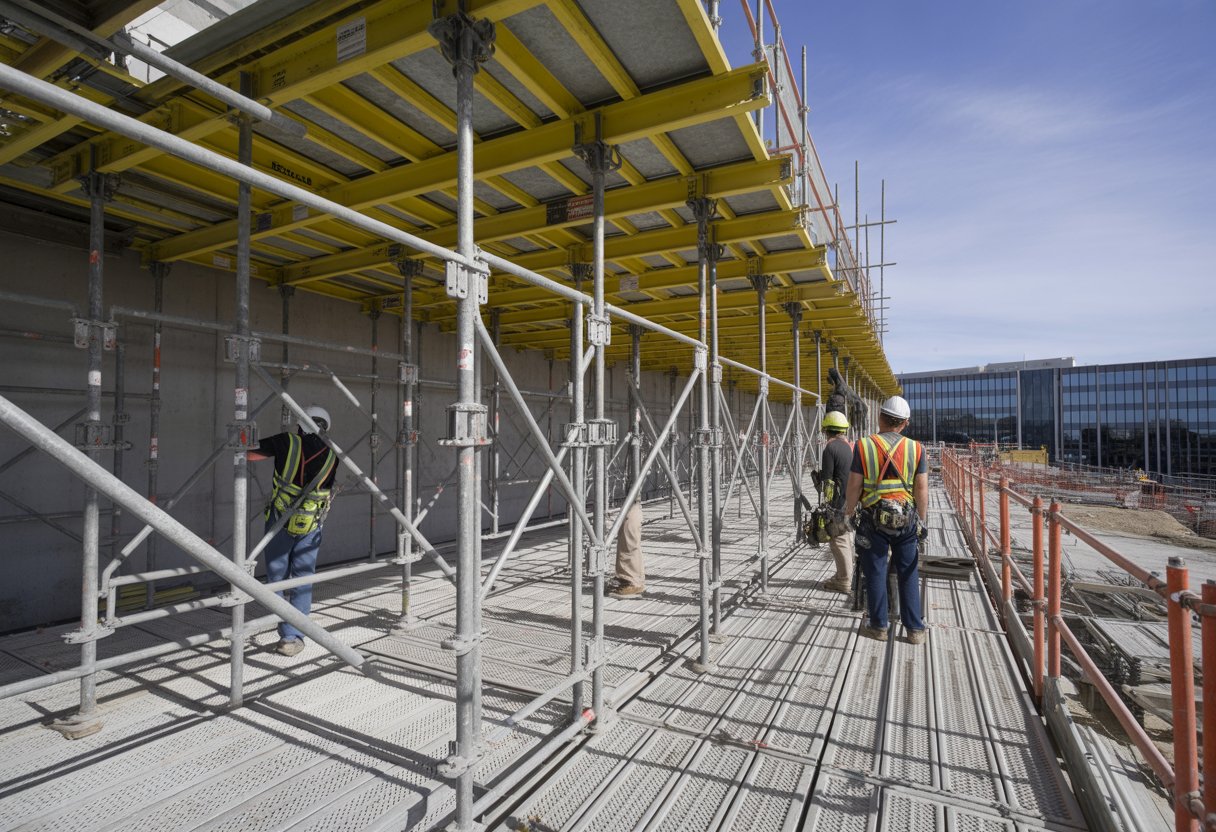
Commercial scaffolding in the UK operates under four main pieces of legislation that set out specific duties for employers, contractors, and workers. These laws establish requirements for risk assessment, equipment standards, competence, and safe systems of work.
Work at Height Regulations 2005
The Work at Height Regulations 2005 form the primary legal framework for scaffolding in the UK. These regulations apply to all work where a person could fall a distance liable to cause personal injury.
You must ensure that all work at height is properly planned by a competent person. This includes assessing the risks and selecting appropriate equipment based on a hierarchy of control measures. The regulations require you to avoid work at height where possible, but when unavoidable, you must prevent falls through collective protection measures.
Your scaffolding must be inspected by a competent person before first use, after any substantial addition or alteration, and at regular intervals not exceeding seven days. You need to keep inspection reports for three months from the date of the inspection. The regulations also mandate that scaffolds should only be erected, substantially altered, or dismantled under the supervision of a competent person by workers who have received appropriate training.
Health and Safety at Work Act 1974
The Health and Safety at Work Act 1974 sets out your general duties to ensure workplace safety. This foundational legislation requires you to provide and maintain safe systems of work, including scaffolding equipment.
You must provide adequate information, instruction, training, and supervision to ensure the health and safety of your employees. This includes ensuring that workers understand how to use scaffolding safely and recognise potential hazards. The Act also requires you to consult with employees on health and safety matters.
Your responsibilities extend to non-employees who may be affected by your work activities, including members of the public near scaffolding structures. You must conduct suitable risk assessments and implement control measures to protect everyone who could be affected by scaffolding operations.
Construction (Design and Management) Regulations 2015
The CDM Regulations 2015 place specific duties on clients, designers, principal designers, principal contractors, and contractors involved in construction projects. These regulations require early planning and coordination of health and safety throughout all stages of a project.
You must appoint a principal designer and principal contractor for projects involving more than one contractor. The principal contractor is responsible for planning, managing, and monitoring construction work, including scaffolding operations. You need to ensure that construction phase plans address scaffolding requirements and that welfare facilities are provided.
The regulations require you to provide pre-construction information to designers and contractors. This information must include details about existing structures, previous use of the site, and any identified hazards. You must also ensure that workers have appropriate skills, knowledge, training, and experience for their roles.
Provision and Use of Work Equipment Regulations 1998
PUWER 1998 requires that equipment provided for use at work, including scaffolding, is suitable for its intended purpose and maintained in a safe condition. You must ensure that all scaffolding equipment meets these standards.
Your scaffolding must be suitable for the specific tasks and environment where it will be used. This includes considering factors such as load capacity, weather conditions, and the duration of use. You need to maintain equipment through regular inspections and repairs to prevent deterioration.
The regulations require you to provide adequate information and training to anyone using or supervising scaffolding equipment. This includes specific instructions relevant to the equipment being used and the work being carried out. You must also ensure that scaffolding is used only by workers who have received adequate training.
Competency and Training Requirements

UK scaffolding regulations mandate that only properly trained and certified workers can erect, alter, dismantle, or inspect scaffolding structures. The Construction Industry Scaffolders Record Scheme (CISRS) provides the primary framework for demonstrating competency in scaffolding work.
CISRS Cards and Certification
CISRS cards serve as proof that you hold recognised qualifications to work with scaffolding. These cards demonstrate that you have completed the required training and assessments for your specific role.
You need different CISRS cards depending on your level of expertise and responsibilities. The main card types include:
- Trainee cards for those starting their scaffolding career
- Labourer cards for workers supporting scaffolding operations
- Scaffolder cards for competent scaffolders who can erect basic structures
- Advanced Scaffolder cards for experienced workers handling complex scaffolding
Each CISRS card has an expiry date. You must renew your card before it expires to continue working legally on scaffolding projects. The cards also require you to maintain your skills through ongoing training and assessment.
Competent Person and Advanced Scaffolder Training
A competent person must supervise all scaffolding work. This individual needs sufficient training, experience, and knowledge to identify risks and ensure safe working practices.
Advanced scaffolder training goes beyond basic scaffolding skills. You learn to design scaffolding structures, calculate load capacities, and supervise complex installations. This qualification requires several years of experience as a competent scaffolder before you can apply.
The training covers structural design principles, materials selection, and advanced safety procedures. You must pass both written and practical assessments to earn your advanced scaffolder status. A scaffold inspector holds additional qualifications to formally inspect and certify completed scaffolding structures for use.
Ongoing Professional Development
Your training does not stop after earning your initial CISRS card. You need regular refresher courses to maintain your certification and stay current with industry changes.
CISRS requires you to complete training updates every five years. These courses cover new regulations, updated best practices, and emerging safety technologies. You must also log your work experience and any additional training you complete.
Many employers provide toolbox talks and site-specific training to supplement your formal qualifications. You should attend these sessions to learn about specific project requirements and safety procedures for each worksite.
Scaffolding Design and Structural Standards

Scaffolding design must follow specific British Standards and guidance documents to ensure structural safety. The type of scaffold, design approach, and calculation method depend on the complexity and configuration of the structure.
General Access Scaffold and System Scaffold
General access scaffold refers to standard configurations used for routine construction work. These structures typically follow predictable patterns and can be designed using standardised guidance.
System scaffolds use prefabricated components that connect in specific ways. The manufacturers provide load tables and assembly instructions for these systems. You must only use components from the same system manufacturer to maintain structural integrity.
Tube and fitting scaffold offers more flexibility for complex shapes and non-standard configurations. This traditional approach uses tubes, couplers, and fittings that can be assembled in various arrangements. You need experienced scaffolders to build these structures correctly.
Each scaffold type has different design requirements. System scaffolds rely on manufacturer specifications whilst tube and fitting scaffolds need more detailed calculations.
Design to British Standards and Bespoke Calculations
BS EN 12811 sets out the performance requirements and general design for scaffolding. This standard covers load classes, materials, and structural safety factors.
BS 5975 provides guidance for temporary works, including scaffolding design. You must follow these standards when creating bespoke scaffold designs.
Standard designs work for common scenarios. However, complex projects require bespoke calculations from a qualified scaffold designer. These calculations account for loads, wind forces, tie patterns, and ground conditions.
You need a competent scaffold designer for structures that fall outside standard guidance. This includes scaffolds with unusual geometries, heavy loading requirements, or challenging site conditions.
NASC TG20 and System Scaffold Guidance
The National Access and Scaffolding Confederation (NASC) publishes TG20:21, the main technical guidance for scaffolding in the UK. TG20 provides design solutions for common scaffold configurations without requiring individual calculations.
NASC TG20 guidance covers bay lengths, lift heights, tie patterns, and load capacities. You can use these pre-calculated designs if your scaffold matches the configurations shown in the guidance.
System scaffold manufacturers provide their own technical manuals alongside TG20. These documents specify maximum heights, loads, and assembly requirements for their specific systems. You must ensure scaffolders have access to the correct guidance for the system being used.
The guidance only applies when you follow all specified parameters exactly. Any deviations require separate design calculations from a qualified professional.
Planning, Risk Assessment and Method Statements
Before any scaffolding work begins, UK law requires formal planning that identifies hazards and establishes safe working procedures. The Work at Height Regulations 2005 mandate that a competent person must create and maintain accessible documentation throughout the project.
Comprehensive Risk Assessment Procedures
You must conduct a detailed risk assessment before erecting, altering or dismantling any scaffold structure. This assessment identifies workplace hazards specific to your site and evaluates the level of risk each presents.
Your risk assessment should cover working at height hazards, ground conditions, weather exposure, and fragile surfaces. You need to document potential dangers from falling objects, structural instability, and electrical hazards near overhead cables.
The assessment must be site-specific rather than generic. You should evaluate the actual conditions where work will take place, including access routes, ground stability, and proximity to public areas. This documentation must remain accessible to all workers throughout the project duration.
Hierarchy of Control Application
Your control measures must follow the hierarchy of control principles. This means eliminating risks where possible before considering other protective measures.
Start by asking if working at height is necessary or if the task can be completed from ground level. If height work is unavoidable, you should use collective protection measures like edge protection and guardrails that protect all workers simultaneously. Personal protective equipment such as harnesses serves as a last resort when other controls aren’t practical.
The construction phase plan should integrate these controls into the broader site safety strategy.
RAMS and Method Statements
Your method statement provides step-by-step instructions for carrying out scaffolding work safely. It incorporates the control measures identified in your risk assessment and forms part of your RAMS documentation.
The method statement must specify the sequence of assembly, the equipment required, and the supervision arrangements. You should detail how base plates will be positioned on stable ground, how components will be assembled, and what inspections are needed at each stage.
Only CISRS-qualified personnel should erect scaffolding, and your RAMS must state this requirement. The document should outline the personal protective equipment needed, including hard hats, safety boots, and fall protection equipment. You must ensure all workers understand and follow these procedures before work commences.
Scaffolding Safety Measures and Protective Equipment
Protecting workers on scaffolding requires multiple layers of defence, including physical barriers on the structure itself and personal equipment worn by individual workers. These measures work together to prevent falls and protect against debris hazards.
Collective Fall Protection: Guardrails and Toe Boards
Guardrails form the first line of defence against falls from scaffolding platforms. You must install guardrails at any edge where someone could fall 2 metres or more. The standard configuration includes a top rail at 950mm, a mid-rail, and toe boards at the base.
Toe boards serve a dual purpose in scaffolding safety. They prevent tools and materials from falling off the edge whilst also stopping workers’ feet from slipping underneath guardrails. You need toe boards that are at least 150mm high along all open edges of working platforms.
The guardrails must be strong enough to withstand a person falling against them. You should check that all components are properly secured and show no signs of damage or deterioration. Any gaps between rails should not allow a person to fall through.
Personal Protective Equipment (PPE) and Fall Prevention
Hard hats are mandatory for everyone working on or near scaffolding. You must wear high-visibility clothing to ensure you remain visible to crane operators and other workers. Safety boots with slip-resistant soles protect your feet and provide better grip on scaffold boards.
Safety harnesses and lanyards become necessary when guardrails cannot be installed temporarily, such as during erection or dismantling work. Your harness must fit properly and connect to a secure anchor point that can support your weight in a fall. You should inspect harnesses before each use for frayed straps, damaged buckles, or other signs of wear.
Work gloves protect your hands from splinters and sharp edges on scaffold components. Eye protection shields you from dust and debris when working above or below other workers.
Loading Bays, Safety Nets and Debris Netting
Loading bays allow materials to be lifted onto scaffolding platforms safely. You must fit these bays with gates or removable guardrails to prevent falls whilst maintaining protection when not in use. The gates should open inwards or slide sideways rather than outwards over the edge.
Safety nets catch workers who fall and must be positioned as close as practical beneath the work area. You need to check nets regularly for damage and ensure they remain properly tensioned and secured. The maximum fall distance to the net should not exceed 2 metres where possible.
Debris netting wraps around scaffolding to stop materials from falling onto people below. This netting also reduces wind load on the structure. You must ensure the netting is properly attached and remains in good condition throughout the project.
Platform Boarding Arrangement and Access Equipment
Scaffold boards must be thick enough to support workers and materials without bending excessively. You need boards that are at least 38mm thick for spans between supports. The boards should extend over their supports by at least 50mm but not more than four times the board thickness to prevent tipping.
You must not leave gaps between boards wider than 25mm. Boards should be secured to prevent sliding or lifting, particularly in windy conditions. Any damaged or warped boards require immediate replacement to maintain scaffolding safety compliance.
Access ladders must be positioned at a safe angle and properly secured at top and bottom. You should use ladder gates or trapdoors in platforms rather than climbing over guardrails. Internal staircases provide the safest access for heavily used scaffolding structures.
Inspection, Record Keeping and Compliance Responsibilities
UK law requires regular scaffolding inspections at specific intervals, with detailed records maintained throughout the structure’s use. Both principal contractors and scaffold contractors share distinct legal duties to ensure compliance with health and safety regulations.
Mandatory Inspection Intervals and Requirements
You must arrange scaffold inspections before first use, after any alterations, and following events that could affect stability such as high winds or impact damage. A competent person must inspect the scaffolding at least every seven days whilst it remains in use.
The inspection must cover structural integrity, foundation stability, platform security, guardrails, toe boards, ties, bracing, and access points. Your inspector needs to verify that all components are properly installed and that no materials or conditions pose safety risks.
Weather conditions can trigger additional inspection requirements. You must organise an immediate inspection after adverse weather events, particularly storms with wind speeds exceeding 40 mph.
Scaffolding Inspection Checklists and Tags
A scaffolding checklist should include foundation condition, vertical and horizontal members, platform boards, guardrails, toe boards, ladder access, debris accumulation, and tie points. You must check that all couplers, fittings, and connections remain secure and undamaged.
Inspection tags provide immediate visual confirmation of scaffold status. Your scaffold contractor typically attaches colour-coded tags indicating:
- Green: Safe for use, inspection current
- Red: Unsafe, do not use
- Amber: Caution, restricted access
Tags must display the inspection date, next inspection due date, inspector name, and any load restrictions. You should position tags at primary access points where workers can easily see them.
Documentation, Handover and Record Keeping
You must maintain written records of all scaffolding inspections for at least three months after the scaffold’s dismantling. Records should include the date, inspector’s name, condition findings, identified defects, and corrective actions taken.
The scaffold handover certificate transfers responsibility from the scaffold contractor to the principal contractor. This document confirms that the structure meets design specifications and complies with safety standards.
Your records must be available on site for review by workers, supervisors, and health and safety inspectors. Digital or paper formats are both acceptable, provided they’re accessible and complete.
Principal Contractor and Scaffold Contractor Duties
The principal contractor controls the construction site and coordinates safety across all trades. You must ensure scaffold inspections occur on schedule, records remain current, and workers only access structures displaying valid green tags.
Your scaffold contractor designs, erects, alters, and dismantles scaffolding according to relevant standards. They must provide competent inspectors, maintain inspection records, and immediately address any defects or safety concerns.
Both parties share responsibility for communicating hazards and coordinating safe working procedures. The principal contractor must not permit unauthorised modifications, whilst the scaffold contractor must respond promptly to inspection findings requiring corrective action.
Frequently Asked Questions
Understanding the specific requirements for scaffolding safety helps you maintain compliance and protect workers on site. These common questions address key regulatory points that apply to commercial scaffolding operations in the UK.
What protocols must be adhered to for securing scaffolding structures?
You must ensure your scaffolding is erected on stable, level ground with proper base plates or sole boards. The structure requires adequate bracing, ties to the building at specified intervals, and guardrails on all working platforms.
Your scaffold must be tied to the building structure at regular intervals, typically every 4 metres horizontally and every 4 metres vertically. You need to install adequate diagonal bracing to prevent the structure from swaying or collapsing.
All platforms must have guardrails at least 950mm high, toe boards of at least 150mm, and intermediate guardrails to prevent falls. You should never leave gaps in the platform that exceed 25mm.
How often are safety inspections required for commercial scaffolding?
You must inspect your scaffolding before first use and then at least every seven days. You also need to conduct inspections after any event that could affect the scaffold’s stability, such as high winds or alterations to the structure.
A competent person must carry out these inspections and record the findings in a scaffold inspection report. You need to keep these records available for review and maintain them for at least three months after the scaffold is dismantled.
What are the minimum training qualifications for scaffolding erectors and dismantlers?
Your scaffolding operatives must hold recognised qualifications that demonstrate their competence. In the UK, this typically means CISRS (Construction Industry Scaffolders Record Scheme) cards or equivalent certification.
Trainee scaffolders need to work under direct supervision whilst completing their training. You cannot allow unqualified workers to erect, alter, or dismantle scaffolding structures.
Your operatives should also receive regular toolbox talks and site-specific briefings. This ensures they stay current with safety guidance and understand the particular requirements of each job.
What guidelines are in place for maximum load capacities on scaffolds?
You must determine the load capacity based on the scaffold’s design and intended use. Scaffolds are classified into different load classes, with Class 3 designed for light duties (up to 75kg per square metre) and Class 6 for heavy duties (up to 600kg per square metre).
Your scaffold should display clear signage indicating its maximum safe load capacity. You need to ensure that materials and equipment stored on the platform do not exceed this limit.
The design calculations must account for both the dead load (the scaffold’s own weight) and the live load (workers, materials, and equipment). You should never overload a scaffold or alter it without proper authorisation and revised calculations.
How should personal protective equipment (PPE) be utilised on scaffolding sites?
You must provide hard hats, safety footwear, and high-visibility clothing to all workers on scaffolding sites. Workers also need appropriate hand protection when handling scaffold components.
Fall arrest equipment, including harnesses and lanyets, is required when working at height where guardrails cannot be installed. You should ensure workers use three points of contact when climbing scaffold ladders.
Your workers must wear their PPE correctly at all times whilst on the scaffold. You need to conduct regular checks to ensure equipment remains in good condition and replace any damaged items immediately.
What procedures should be followed in the event of a scaffolding-related incident?
You must stop work immediately if a scaffolding incident occurs and secure the area to prevent further access. Your first priority is to ensure injured persons receive appropriate medical attention.
You need to report serious incidents to the Health and Safety Executive under RIDDOR (Reporting of Injuries, Diseases and Dangerous Occurrences Regulations). This includes fatalities, specified injuries, and incidents resulting in workers being unable to work for more than seven days.
You should preserve the scene for investigation and document the incident with photographs and witness statements. A competent person must inspect the scaffold before you allow any work to resume.
Need Professional Scaffolding for Your Project?
Contact us now:


